4 Surprising Skills of Highly Engaging Manufacturing Leaders
The manufacturing industry is unlike any other: continuous improvement mindsets, intricate supply chain management, and quality control standards leave no room for even the smallest of errors. To be a leader in such a highly precise and continuously evolving industry naturally requires certain skills, but is it really that different than leadership elsewhere?
As it turns out, yes. In a recent study with one of our top manufacturing clients, we compared their leaders’ scores on the Pinsight Leadership assessment with results from the organization’s engagement survey. The engagement survey asked each team to reflect on their motivation to go above and beyond in their role, their plans to stay with the organization long-term, and their pride to be a part of the team. Engagement is a key predictor of several important work outcomes like performance, customer satisfaction, and even company profit, so understanding why certain leaders are better at keeping their teams engaged is crucial for the health and growth of an organization.
What we found was surprising. Leaders of the most highly engaged teams tended to have significantly different scores than the leaders of the lowest engaged teams in several key skill areas, and we noticed the strongest trend in an area that seems uniquely oriented to leaders in manufacturing. Specifically, leaders who were skilled in prioritization, organization, methodical thinking, and innovation emerged as having the most highly engaged manufacturing teams.
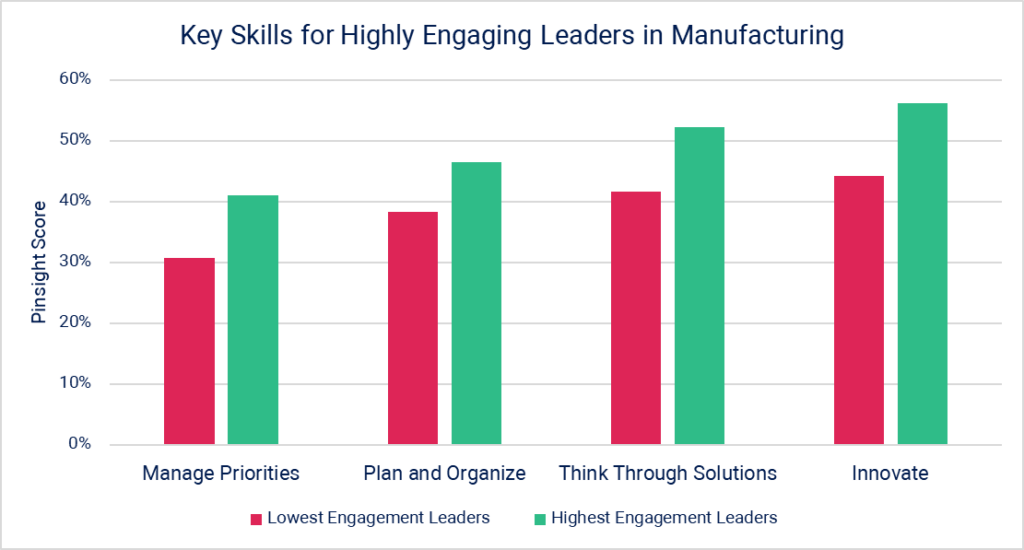
Since engagement is typically associated with “softer” factors like communication, empathy, and teamwork, it may seem counterintuitive that cut-and-dry leadership skills like planning and organizing would be so strongly correlated to a team’s engagement. But under the lens of manufacturing, this makes sense for a few key reasons:
- If you’re in the manufacturing industry, it doesn’t matter if you work third shift on the production floor or as the VP of an entire department: you abide by the same values that emphasize a disciplined and precise approach to work. So in an industry where precision and efficiency reign supreme, advanced planning and organizational skills are essential and valued by all types of teams. Leaders can foster engagement by creating a structured environment that optimizes workflows, because this reduces strain for everyone and allows the team to work without bottlenecks or ambiguity. In an industry that values structured thinking and carefully thought-out processes, direct reports are bound to be more engaged by a leader who embodies these core manufacturing principles.
- Continuous improvement is perhaps the most universal competency across all types of manufacturing. Regardless of what your organization is building or producing, those in manufacturing understand the criticality of always being better, faster, and leaner. Leaders who both encourage this innovation mindset in others, as well as live it themselves, are going to have teams who feel more capable of navigating challenges, adapting to constant change, and seeing the positive in risks.
It’s intuitive that the best leaders are the ones who are aligned with your company culture and core values. This study lends support to that intuition with real data, and emphasizes the surprising ways that a leader’s cultural alignment can manifest at the team engagement level.
Does your organization need to increase the engagement? Book a free talent consultation with us HERE!
‹ Previous PostNext Post ›